Maybe you’ve heard the word “arboretum” thrown around and wondered how they differ from a stand of trees in the forest. What makes an arboretum special is the connection between people, trees, and education.
An arboretum can be defined as a “living museum of trees and woody plants, grown and cared for by an organization committed to their stewardship” (ArbNet). In other words, it’s a collection of trees that are intentionally cared for by an organization, usually for a specific purpose. Some of those objectives can include environmental or genetic conservation, scientific research, community engagement and education, or even as simple as public awareness and enjoyment of trees. These spaces allow not just for a nice place to take a stroll but also to engage the public in learning more about these specific tree species or broader conservation work.

By Emily Kresin. Emily is a former Heartland Tree Alliance Community Forestry Associate.


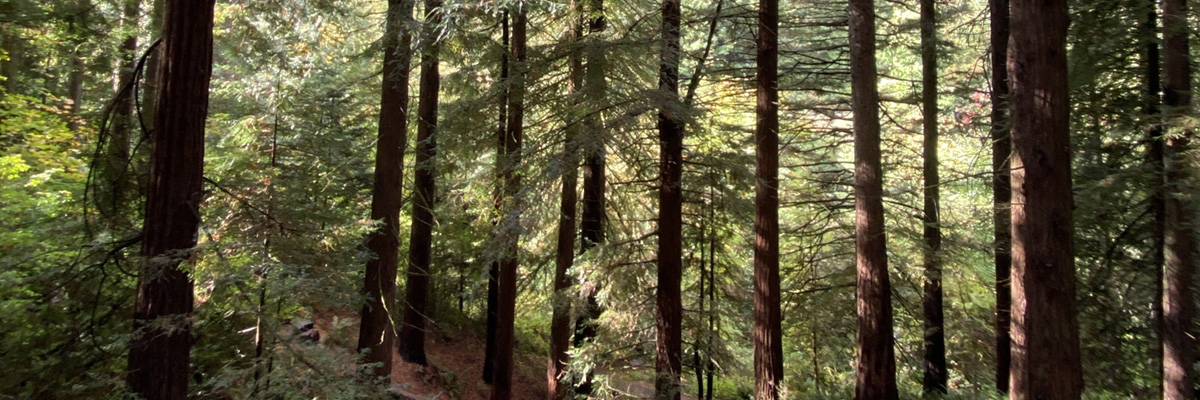
Pictures from the Redwood Deck (left) and of a White Barked Himalayan Birch (right) from Hoyt Arboretum in Portland, OR (Emily Kresin)
There are a few qualifications that must be met for a tree-keeping organization to have a site be considered an arboretum. ArbNet, the international accreditation program for arboreta, has four levels of arboretum accreditation. The simplest level (Level 1) must include an arboretum plan, organizational management with volunteer or paid staff, contain over 25 trees, and host at least one public educational event per year. The highest level (Level 4) includes additional qualities like having over 500 trees, scientific staff and a curator, collection management policies, and more substantial scientific research and educational programming. For example, the Chicago Botanic Garden in Illinois would be considered a Level 4 while Kansas City’s Union Cemetery is considered Level 1. A full map of all the international ArbNet registered arboretum sites can be found on their website.
Heartland Tree Alliance (HTA) has been able to plant and maintain our own arboretum sites throughout Kansas City, each with different themes. While our arboretum sites are not officially accredited through ArbNet, these sites do meet the Level 1 criteria. One of HTA’s largest arboretum sites is along the Blue River Trail at Minor Park. The theme for Minor Park’s arboretum is Missouri native trees and the site highlights 41 different tree species that are locally adapted to Missouri ecosystems.
This site also includes a new digital feature: a virtual walkthrough StoryMap that includes additional information about the history of the site, tree species information, and pictures. Each tree has a point on the map that corresponds with the same tree on the ground. Users are able to pull up the StoryMap on their mobile device while walking alongside the trees to learn more about each species. It also offers a way for individuals who are unable to visit the site in person to do a completely virtual walkthrough of the site.

Minor Park StoryMap – a virtual walkthrough of the arboretum trees planted by HTA
HTA has planted and maintains a few other arboretum sites, including Essex Park (theme: trees for pollinators), James A. Reed Park (theme: trees for spring and fall) and Winnwood Park (Missouri native trees). Alex George Wetland (theme: trees for pollinators) will be getting additional trees added in the fall 2026 planting season. There are several other arboretum sites not maintained by HTA throughout Kansas City such as Union Cemetery, Loose Park, and Elmwood Cemetery. These three sites also have a few KC Metro Champion Trees on their grounds (very large and old trees), which you can check out here.
Arboretum sites are a great way to connect yourself to nature and your community. If you love learning about trees, consider visiting an arboretum on your next walk!

A beautiful Catalpa tree at Union Cemetery (Emily Kresin)