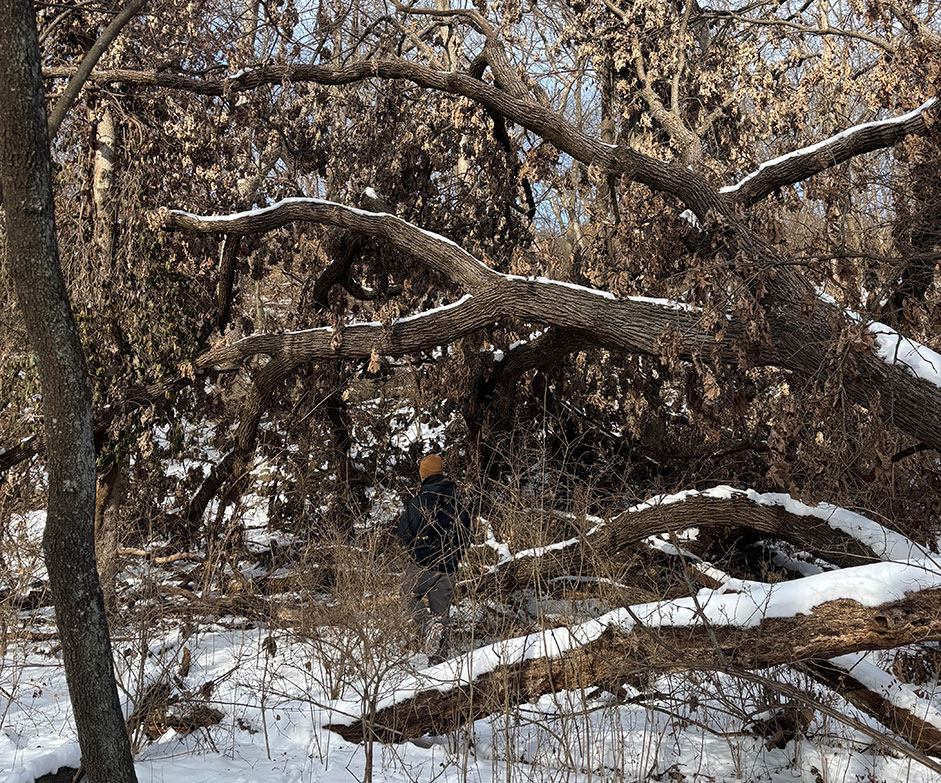
When walking in the woods near my dad’s childhood home, my mind often wanders. This time of year, the leafless trees give way to a spiraling beauty that had, for months, been hidden in the tree tops. However, a particular site has been calling me and my imagination back since it stopped me in my tracks this fall. In the deepest and lowest point in these woods, I found a fallen oak tree.
This once towering oak now sits dead in the creek bed with its cracked truck giving way to an array of limbs and branches which stretch along and from the forest’s floor. As I walk along the horizontal trunk like a balance beam, I think of aunts, uncles, parents, and grandparents who used to look up at this now fallen giant with admiration whilst haggling about the age of the tree. After they agreed to settle on the age of “old” perhaps they concluded the ceremonial admiration with a few pats on the tree’s trunk and uttered a simple, “That’s a nice tree.”

By Thomas Mitchell. Thomas is a Heartland Tree Alliance Forestry Associate.

The downed oak tree with a person for scale.
After my mind has wandered to all the awe and life which this tree supported, I begin to look around at the surrounding scrubby vegetation and notice that I don’t see any oak saplings racing to fill this now massive gap in the tree canopy. In fact, I don’t see many new trees filling this gap at all. Instead, I only see a dense thicket of invasive bushhoney suckle, privet, and burning bush with their scratching and eye poking twigs (if you’ve ever removed honeysuckle, you know they can fight back). I then sadly realize that, if left unmanaged, oaks like this fallen beast will be a thing of the past, and our beautiful oak woodlands and savannas will become a tangled mess of invasive species. This is because most oaks are not tolerant of shade and are also very slow growing. Therefore, these magnificent trees quickly get out competed by invasive species that are fast growing and form dense thickets. These thickets shade out the next generation of oak saplings not allowing the aging, old oaks to naturally regenerate.

The ecosystem services of oaks include providing food, habitat for insects, and feeding organisms in the soil.
Source: Ken Carloni at Umpqua Watersheds
If we continue to let our woodlands slowly decline into seas of invasives, it will not only mean that we won’t have beautiful oak trees to look at, but it will also severely impact many facets of our local ecosystems. Oak trees are keystone species meaning they play an outsized role in the life cycle of other organisms in our area by providing food, shelter, and many other ecosystem services. For instance, oak trees produce acorns which feed squirrels which in turn feed many predatory birds such as bald eagles and hawks. These protein rich acorns are also enjoyed by turkeys, deer, foxes, opossums, woodpeckers, and blue jays (just to name a few). Oaks also live a VERY long time (a Burr oak in KCMO was just removed that is older than the United States) which means one oak tree can fill these ecosystem roles for centuries. Oaks are in it for the long haul and it’s no wonder why many cultures associate these breathtaking trees with wisdom and strength.
Although the beauty of many invasives is hard to dismiss, there are numerous non-invasive, native species that are both pretty and provide lots of ecosystem benefits. If you are drawn to the showy and fragrant flowers of bush honey suckle, consider planting elderberry, ninebark, or northern bush honeysuckle (which is native to the eastern US), and, if you have the space, plant a native oak tree!